• Home
  • About Me
  • Services and Offerings
  • Contact Me
  • Social
    • YouTube
    • Instagram
    • Facebook

Dave Rothrock's The Ranting Angler:

Old Musty Opinions, Observations and Such.


Think about starting out with a 6 1/2' Shakespeare Wonderod.  Not the most desirable tool available for the task, is it?  Yet, that's what I had.  And you know what?  It worked!  As time passed I moved to a 7' Fenwick.  No graphite rods back then since they hadn't yet hit the market with any real impact.  And both the Wonderods and the Fenwicks were considered some of the better glass rods in the day. 

Talk began to circulate about the new and greatly improved material called graphite.  I figured it was time to make the switch and I became the proud owner of a Fenwick 8' 5wt. graphite rod.  Wow!  What that rod did for my casting was amazing...or so I thought.  I think there was some play on psychology going on with that one.  

It was about this time I was introduced to more advanced ways to fish nymphs;  however, the emphasis was on more effective ways to detect takes and that was all in the leaders.  Rod length and, along with that, line weights weren't a point of focus.  As I remember most of my trout fishing, regardless of whether I was fishing dry flies, wet flies or nymphs, was with rods of around 8' in length.  Pretty much making do with what we had.

Along comes the 9' rod.  Definitely a rod length that provided me as a fisher of nymphs an advantage.  Much better reach for expanding my zone for effective presentations.  My rod of choice became a 9' 4 wt. and I wanted it in at least a medium-fast action.  My thinking was - and still is - that a faster action rod transmits strike response from rod tip to fly more quickly;  hence, more and better hook-ups - I hope!.

For many years I stayed with my 9' 4 wt. rods.  They handled all that I put them through with no problem.  O.K., O.K., you got me.  I snuck a 9' 3 wt. in there at one point for use in skinny water situations.  Yeah, there were some 10 footers available but, after having casted one now and then, I felt they weren't anything I'd want to consider adding to my rod inventory.  It's important to emphasize that while I used my rods for nymphing I also used them for fishing dries.  I felt that the long rods early on were heavy and...well, flat out clumsy and/or clunky.  Not something I'd derive any pleasure from fishing, for sure.

Then, along came my involvement in the world of competitive fly fishing.  Nope, I didn't compete;  rather, I was brought on as a board member for the U. S. Youth Fly Fishing Team.  I was also invited to be one of the instructors. Now I'm seeing all of these 10' rods in the hands of these young anglers.  And, not surprisingly, they were primarily fishing nymphs.

The long rods used by competitors weren't like the 10 footers of yesteryear.  They were actually not bad.  Still not enough to get me really interested.  I just didn't like the soft tips.  So, what did I do?  You guessed it:  I kept fishing my 9 footers.

I finally convinced myself that consistent reasoning must apply here.  If a 9' rod gave better reach then it should go without saying a 10' rod would give me even more.  Throw in the versatility requirement here.  The rods I use must serve me for more than drifting nymphs subsurface.  I am absolutely not one who would carry multiple rods when I'm on the water.  Nor would I ever want to find myself in a position to wish my vehicle were close by so I could go back and get my other rod to fish dries.  So, here's where I stand in regard to my rod choices.  Forget the drum roll and let's get to the meat of the issue. 

The rods sold today as Euro nymphing rods run from 10 to 11 feet in length and, for the most part, are listed for 2 through 4 wt. lines.  I find this a bit interesting since I believe that most anglers who purchase and fish these rods don't use double tapered or weight forward fly lines to fish nymphs. I believe the angler who actually uses a line weight matched to the rod is far and away the exception. Yes, I'm an exception - and one of a different sort, at that - but we'll get into that in more detail when PART 3 goes up on the blog.  While there appears to be a good number of anglers using an all mono rig most others seem to favor a Euro nymphing line which is level and .022" diameter.  Another interesting point is that some manufacturers tout these lines as for use with rods up to 5 wt.  Anyone familiar with tip diameters of fly lines and the increase in diameter as the taper progresses?  I am and I'm here to tell you these tapered lines are nowhere close to .022".  So, the question begs to be asked:  why the line weights?  Somebody want to pop in here and give me some insights??  Oh, and there's more but that, too, will have to wait until later in the series.

I believe that rods longer than 10' become specialty tools and that means they're single use rods.  At this point in time this eliminates my considering a rod beyond 10' in length.  I can tell you from a fair bit of experience that my 10' rods will present a dry fly at distance  with acceptable accuracy.  The label I'd attach to some 10' rods is...versatile in application.  All of this begs another question:  if these are marketed and sold as nymphing rods how much design thought went into using these rods to actually cast?  Hhhmmmm.  Longer rods?  Meh.


I'm sure that the vast majority of anglers would agree that as we consider the differences in rods as line weight ratings get lighter at minimum the rod tips get what we'd describe as softer.  This has a significant bearing on how broad a range of conditions certain rods may preform acceptably for nmphing.  I fish 12 months of the year when conditions warrant.  That means I encounter stream conditions from heavy, deep flows to low, skinny flows and everything in between.  I've found that it takes a stiffer rod tip to cast heavier weight with acceptable accuracy.  The more weight the more difficult it is to control the path of that weight.  I don't care what form that weight takes.  It's the same whether the weight is in the fly or on the leader.    

Then we have to consider what happens when we react to what we interpret as a trout intercepting our nymph.  Obviously, it's called the hook set.  There's a bit more to setting the hook with weight deep in the water column.  Both the weight and the current flow act to resist my effort to pull hook point into fish flesh.  The heavier and deeper the flow the more weight it takes to get the fly/flies down to the depth at which I want them to drift.  All of these factors combined means that it requires more on the part of the angler and the rod to counter that resistance.  The softer the rod tip the more difficult it is to do so with any authority.   Not only do I want to get that hook into the trout I want to do it as fast as possible with as much force as my tippet will withstand.  That means I hit hard and fast - relatively speaking.  The stiffer the rod tip the better I'm able to counter the resistance and get the action of the hook set to move the weight and the fly/flies.
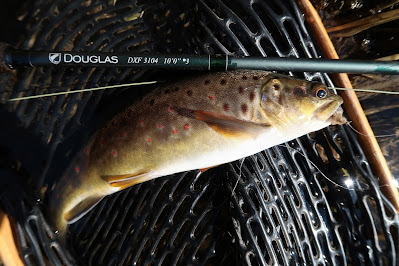


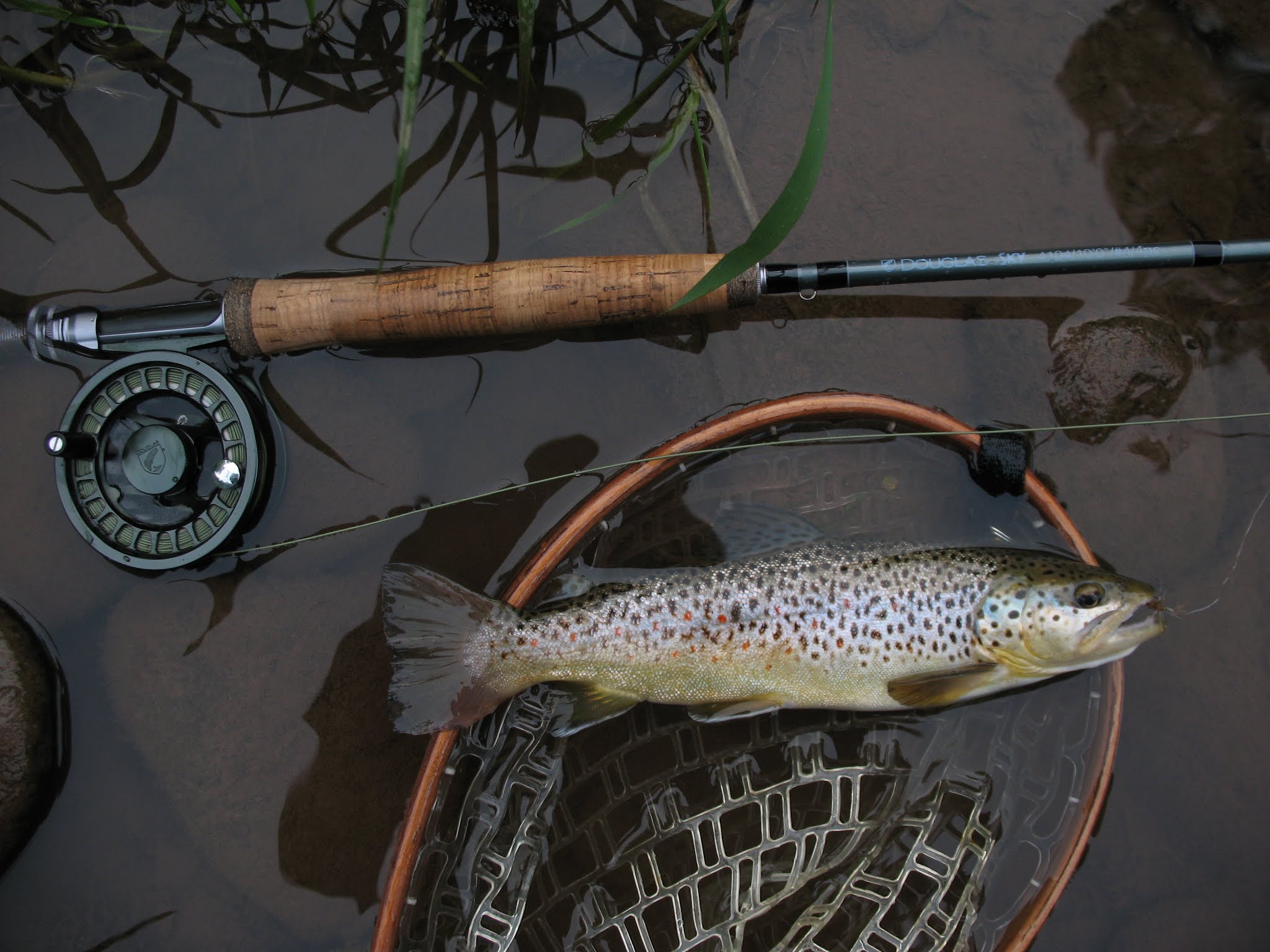
Here is where the statement "there's no one size fits all" meets reality.  From what I see and based on the statements of many of my peers a 3 wt. rod seems to be the most popular choice among most anglers who fish sighter systems.  However, based on my experience my 10' 3 wt. Douglas DXF will handle up to about 1.2 grams of weight and, in a pinch, if I really have to, 1.6 grams (I said grams not grains as this differentiation will become important later in the series).  Anything more and it becomes more difficult to present and my hook set becomes what I can best describe as sluggish.  My Douglas Sky 10' 4 wt. is my rod of choice when I fish deeper, heavier flows with more weight.  I guess I have to give up a confession here.  My 10' 4 wt. is capable of handling most of the conditions I may encounter right down to skinny water.  It's that versatile.  So, why the 3 wt.?  It's a bit more fun and a bit more sensitive when I only need a little weight to get my flies to drifting at depth.  Still versatile, just not quite as much as the 4 wt.  Another confession.  Sometimes I do lament the fact that these rods are a bit softer than I'd like.  I know, woe is me!             
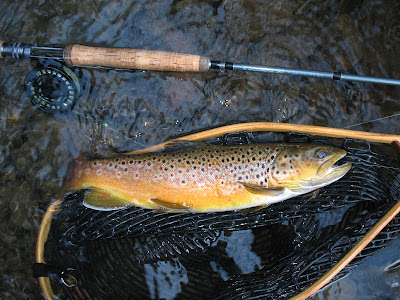


Some of you may notice I didn't mention anything about a 2 wt.  Sure, there are those anglers who choose a 2 wt.;  however, I feel these rods are specialty rods best used when flows are low normal to really low and little weight is used.  That's not for me.  In fact, based on conversations I've had with some anglers I believe there are those who push these rods well beyond what I consider their acceptable limits.

Since this is my approach to rod choice and, true to the title of this blog as being my opinions, observations and such, I thought it good to run them by...of all people...one who designs fly rods.  Here's where being a member of a pro-staff has it's benefits.  

Fred Contaoi is the chief rod designer for Douglas Outdoors.  Fred knows his stuff since he's designed award winning rods for Douglas over the past years.   First, he confirmed my position that the longer a rod the more difficult it is to cast - note, I said cast accurately.  It's a stability thing.  Rods over 10' long are designed for nymph fishing.  Second, he affirmed my position that the softer the tip the less weight it will cast accurately and the more sluggish the strike response with a lot of weight in deeper, heavier flows. Thank you, Fred!! 

While I could go on - and I just may allude to using a 9' 6 wt. for a specific type of nymphing later in the series ... maybe - I'd be remiss if I didn't address fishing small streams.  There are streams I fish where a 10' rod makes casting and fishing more difficult than I'm willing to tolerate.  Tight conditions call for a shorter rod and that's where my 9' Douglas DXF 3 wt. is my fishing tool of choice.  Believe me, a foot of rod length can make a big difference.  And we all now know my lengthy experience with 9' rods.

I'll end my take on rods with this statement.  I believe that the issue of sensitivity is a bit overrated.  While I can feel a trout take my fly now and then this is, based on my limited experience, primarily a visual game.  Visual first, tactile second.  There's some controversy for ya'!

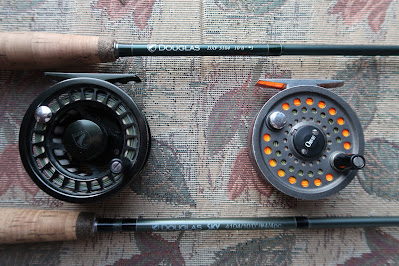
While I've spent a bunch of time discussing rods I have a much simpler approach to reel choice.  Let's begin with a story related to me by a manager of a fly shop.  An angler enters the shop and wants to check out a rod for Euro nymphing.  He looks the rod over and mentions that the rod is a little heavier than what he was looking for.  Fly shop manager looks at him and asks how much the reel he's using weighs.  This angler had never even thought about his reel.  He had no clue!

When I consider a reel for my nymphing rods the weight is one of the most important factors.  Since I'm only looking at reels in the smaller sizes, usually for 2 to 3 or 4 weight lines, these will be the lightest reels available.  Surprisingly, there can be quite a variation in how much these reels weigh.  To me a difference of an ounce and a half or so is a major difference!

Why is the weight of a reel so important to me?  I'm holding my rod and reel out in front somewhere around chest level for what amounts to be a substantial length of time throughout my fishing day and when fatigue sets in it becomes a chore to do so.  The lighter the weight I'm holding the longer I can fish before fatigue becomes an issue.  And I want to fish as long as I can!

I could say that a good drag is important and ... well, it is.  The drag needs to be adjustable down to a point that will protect very light tippets.  By this you should be past the point of just guessing I like to play fish off the reel and, you would be correct!

Finally, for those of you who thought I forgot something, I pay no mind to balance.  It's just a non-issue with me.   

For me, I'm pretty sure I'll be looking at a new reel or two in 2022 and now everyone who reads this will know a good bit of what will be driving my decision making process.

And there you have it.  Dave Rothrock's perspective on rods and reels for fishing nymphs.  Let's keep foremost in our minds that this is how I approach these topics.  There's a reason equipment sales go way beyond that which I choose.  And yeah, there's a reason God created vanilla and chocolate!

Stay tuned for Part 3 of the series addressing my perspective on lines and leaders.  Here's where things will get way more interesting!     
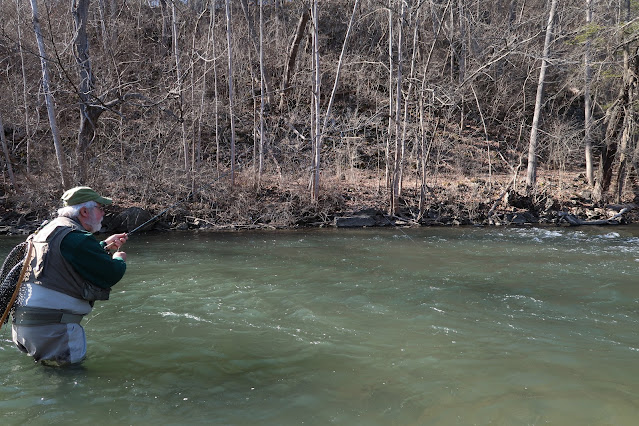


Nymph fishing seems to be one of the hottest fly-fishing topics of the day.  I'm asked every now and then about it by individuals as well as having groups invite me to present on the topic.  Over the years I've developed and refined my approach to fishing nymphs so I guess we'd be accurate in saying I do it MY WAY.  Yup, I've developed the Dave Rothrock approach to nymph fishing.  It's not something that's set in stone since I'm always analyzing what I do to improve where I can;  however, there's one key thread that runs through everything I do.  I need to ensure that my system is versatile and allows me to adapt to changing conditions.  As with anything there's no "one size fits all" here.  And, yes, adapting to changing conditions includes, for me, being able to switch quickly and easily when trout begin feeding on the surface.  

With all of the printed material and videos on the subject I've decided to jump on the bandwagon and share my approach to nymph fishing.  To start it off I thought it appropriate to provide some background as to how it all began for me.  I'm calling this initial segment an introduction of sorts.  I believe it sets the tone for that which is to follow.  

My nymph fishing journey (a journey which I will never complete) began way back in 1972 when, having read a few articles on the subject in major outdoor magazines complete with photos of artificials, really hit me hard.  I had to give it a try.  After all, it made sense to me that this nymph fishing thing just might be the way to catch more trout.  

One Saturday morning in January I proceeded to head to the Catoctin mountains of Maryland.  I had tied a few flies to copy a nymph I had seen in one of the magazines thinking that, if it caught trout for the author it just might catch a trout or two for me.  At the time I thought the fur I was using was hare's ear;  however, later I was to discover it wasn't.  It was mink.  No big deal, it looked buggy and that's what I thought I wanted.  

When I arrived at Big Hunting Creek I put my 6 1/2' fiberglass Shakespeare Wonderod together, secured my reel in the reel seat, ran the line through the guides and tied one of my nymphs onto my tippet.  There's no question I had no idea what I was doing but I was determined to do it.  Let's face it.  If there wasn't much info on how to fish nymphs certainly there was little to no info on equipment and set-up.  I was left to my own devices:  truly the school of hard nocks.  

I knew that nymphs were to be fished along the stream bottom and, since my nymphs weren't weighted, I needed to attach a split shot to the leader about eight inches above the fly.  I had a lot of experience fishing bait on a spinning rod so I set everything up similar to what I would if I were drifting a salmon egg or a piece of corn.  Yes, you read it right:  corn.  It was a lot less expensive than salmon eggs and trout would take a kernel of corn just as well as they'd take a salmon egg.

Cast upstream, drift the nymph downstream.  Try to get a natural drift.  Repeat.  When the drift is interrupted set the hook.  It's either bottom or...  Sure enough, I caught not just one but a few hatchery rainbows my first time fishing nymphs.  Ready for the pun?  I was hooked! 

Today the hot technique - that is, the one which gets the most attention - is Euro nymphing.  Gads, it nearly pains me to call it that.  Why, you ask?  Well, even if you haven't asked I'll tell you.  

We're going to have to go back in time again, this time to the mid-1970's when I lived in the southeast part of Pennsylvania.  I was fortunate enough to be around some young fly-fishers who were way ahead of their time.  There were two or three who were really into fishing nymphs.  Back then nymphing wasn't something that was popular.  In fact, most anglers didn't seem to want to be bothered with it.  Fortunately, that wasn't the case with these young anglers.  And, it certainly wasn't the case with me. 

These young bucks were experimenting with tying nymphs to suggest the naturals as well as more effective ways to fish them..  My interest in tying more suggestive patterns wouldn't develop until later.  However, when it came to working on fishing nymphs - and, in partucular, detecting takes - this is where these anglers could only be described as incredibly innovative.  Can you imagine incorporating a sighter in the leader back in the mid-1970's?  They did it.  And it wasn't long until I was introduced to it and started fishing with long (for the times) leaders and with sighters, too!  

Way back when we had no knowledge of the term "sighter."  In fact, this would remain the case for years.  When I wrote an article which appeared in FLY FISHERMAN magazine titled "Tiny Nymph Tactics"in 2001 I introduced my leader and called it a vari-colored leader.  It truly was a vari-colored leader since it not only had a bright yellow sighter but also a butt section of fluorescent clear blue Stren mono.  

Years later I engaged in a conversation with a fellow angler who happened to be from Poland.  Imagine my surprise when he informed me this technique for nymphing was developed there sometime in the mid-1970's.  I've said numerous times that if there had been some promotion/publicity back then we could just as well have called it PA nymphing.  Unfortunately, I don't receive much positive feedback when I say that.  Oh, well... 

Some people seem to get a bit upset when I state I'm not sure how to define Euro nymphing.  After all, there's Czech, Polish, French, Spanish, and who knows whatever else nymphing.  Oh, and let's not forget Pennsylvania.   I've finally settled on anything that would fall within the Fips-mouche rules for competitive fly fishing.  What seems to bother some folks is that my definition eliminates the mono rig, placing flies closer than the minimum allowed by the competition rules and...you got it...adding weight to the leader.

So, now it should be as clear as an early spring limestone-influenced stream flow - not murky, just a bit milky - why I don't like to use the term "Euro nymphing."  I could call it high-sticking, tight-lining or contact nymphing;  however, I can relate all three of those to fishing with an indicator, as well.  Yeah, sometimes I'm just downright difficult.  So, here I get to introduce to the fly fishing fraternity a new term.  Drum roll, please!  Here goes!!  I like to call it SIGHTER NYMPHING!

Today, it seems to me that many anglers come to sighter nymphing from indicator nymphing.  Logical thinking on my part since nymphing with indicators was popular a fair bit before sighter nymphing gained exposure primarily from the competitive fly fishing scene.  Obviously, this wasn't the case with me.  No such thing as indicators back when I started drifting nymphs along the stream bottom.  In fact, for many years I scoffed at using indicators.  I came up with all sorts of reasons using an indicator was bad for drifting nymphs.  Unfortunately, I hear quite a few folks who use sighters say the same thing I said all the way into the mid-90's.  That was about the time that, for me, something changed. 

In the mid-90's I got the hair brained idea that, after more than 20 years of doing it, I wanted to write a book on nymphing.  I mentioned this to one of my peers while we were attending a fly fishing show in New Jersey.  He proceeded to tell me that a prominent publisher of fly fishing books was at the show and even pointed him out to me.  I walked up to the publisher, introduced myself, explained what I would Iike to do and when the conversation ended I walked away shaking my head.  Did I just get the green light to go with this project?  It was then that reality hit me across the side of my head with it's open hand.  I didn't know nearly as much about this thing called nymph fishing to write about it with confidence based on experience.  Besides, I'd never yet fished a nymph with an indicator!!  I realized I had much to learn before I could speak with authority.  And learn I did.  In fact, I'm still learning! 

As many of my fellow fly fishers do, I have come to a point where I have chosen my equipment preferences - rods, reels, lines, leaders and flies - for specific reasons.  My approach to the nymphing game may be quite different than that of other well seasoned anglers.  And when it comes to tactics I have settled on those which I believe provide me the best advantage on the water.  I've been at this game long enough to recognize that I am required to compromise frequently to achieve a desired effect.  It's important for me to be able to justify to others, and especially myself, why I use what I use and why I do what I do.  I also recognize that improvement requires a dynamic approach.  

As I stated earlier this is all about Dave Rothrock's approach to nymphing for trout.  With the introduction now out of the way there will be four more segments to complete the series:   1) My choices for rods and reels and why;  2) My choices for lines and leaders and why;  3) My choices for flies and accessories and why, and 4) Strategies and tactics.

Hopefully, those who follow this series will learn a little about nymphing but, more importantly, I want to stimulate thought about this most fascinating facet of fly fishing.  It's how we move to improve!


The sphere of controversy regarding fishing for trout seems to be growing faster than I can keep up.  We hear talk of how hero shots and grip-and-grins when photographing fish needs to end and now we expand into another area of concern:  one which offers some interesting points to consider.

So much of this seems to be driven by the fact that many of our rivers (most applicable to the trout waters out west) and streams (most applicable to our eastern trout waters) feel the stress of high temperatures (I believe this means water temperatures) and increased angling pressure at the same time.

Those of us who feel the need to keep up with the latest fishing-related news are aware of the drought conditions plaguing the west and various actions proposed and adopted to address those stressed waters and the trout.  On the flip-side, here in the east it's a different ball game.  We had our time of it last year.  And, believe me, it wasn't good!

On it's face using these two factors as a lead-in makes for the beginnings of a good case.  But, at least the way I look at it, it's the beginning of a developing problem.  You may be thinking, "O.K., Dave, why would you say that?  Well, read on and I'll tell ya'.  

From what I see there's a really big difference in the way fishing is viewed - and managed - out west.  I see that there's more "high profile" talk about crowded conditions and fishing when water temperatures rise.  And that's not necessarily a bad thing.  To contrast, I'll use my home state of Pennsylvania.  And, since I live just shy of the middle of the best PA has to offer trout anglers I'd say I have a bit of knowledge of what goes on here and I not only get to see it I get to hear what folks are doing and saying.  Of course, there's always social media that may, at times, provide a snap shot of what anglers are thinking.  And, regardless of how you may feel about it, there's the issue of climate change and it's purported impact on that which is near and dear to us.  

I'll admit that I can't understand why you would close fishing down on a specific waterway in the early afternoon whether it's out west or anywhere else.  Yeah, I recognize that the decision is driven by water temperature.  And, yes, I understand that the span between daytime highs and nighttime lows may be significant.  And I'm pretty sure the decision to close is supported by anglers, as well.  I've said it many times already.  If water temp. is expected to rise above the limit of acceptability at any point during the day the ethical thing to do is DON'T FISH.  PERIOD.  Hooking, playing, landing, removing the hook and releasing a trout earlier in the day takes it's toll and with water conditions as they are I'd say their recovery time is extended.  Too, that trout is now back into the same environment where it is susceptible to being caught again.  As the day goes on the stressful conditions only deteriorate.

Here in PA we don't have any of that.  None of our public trout waters have ever been closed to fishing during stressful conditions.  Only recently has our fish and boat commission advised against fishing for trout when they're gathered at the mouths of cold water tributaries or at other cold water refuges during these periods.  There's a reliance on anglers choosing to engage in ethical practices.  And if you're wondering, this is what happens on some of our most prized wild trout streams.  That's right, no legal restrictions.  Just hope anglers do the right thing.  Unfortunately, not all do.  In fact, I'm still amazed at the number of fly-fishers who don't know that there is an ethical cut-off.  And then there are those who don't seem to believe it - or just don't care.

Now, let's talk angling pressure   I could almost glean from what's said that there's a feeling that more anglers fishing more often could be a significant contributor to declining trout populations on some western waters..  I'm not saying it ain't so;  however, I've got to wonder if a segment of the angling public - especially that segment which focuses so strongly on this factor - has any real understanding of what we see here in PA.  Let's put in clear perspective.  Our most well-known trout waters are smaller in size than those more popular waters out west AND we have more anglers fishing for trout than most any other state in the nation.  We used to rank at the top of the list for numbers of trout anglers.  If we've slipped it sure isn't by much.  I guess you could say that we have far more angling pressure per surface acre - or any other measurement you'd like to apply - than anything out west.  I'd venture to say that we have a lot more angling for trout over a 12 month period than any trout water out west, too.  I know we have seen an obvious increase in anglers over the last two years as a result of COVID.  That's a given.  Fact is, PA just saw big numbers of anglers grow to a bit bigger.  I'll gladly listen to anyone who would like to prove me wrong here.  All of this begs the question:  is the angler pressure increase factor more significant per angler on smaller waters than on larger waters?  Hhmm, interesting.

What about an increase in angling pressure and a decline in a trout fishery:  is there a nexus here?  I'm not a fisheries biologist, for sure.  However, I've been around this stuff long enough to look for hard facts - data - to support allegations.  We should all acknowledge the fact that fisheries experience ups and downs.  It's the nature of the beast.  I don't know of one person (not saying they don't exist) who would disagree with the statement that there are many factors which may contribute to a population decline in any particular wild trout fishery.  To answer the question:  yes, there is a nexus.  If anglers are responsible for, say, a 5 percent mortality rate then each additional angler adds to the overall mortality which occurs as a result.  Here's where the waters get a little muddy.  While I'm not going to get deep into the hypothetical math it's all dependent on how effective the anglers are at catching trout.  Remember the old adage "10 percent of the fishermen catch 90 percent of the trout."  Well, studies reveal that's pretty accurate.  Based on my observations over a relatively long time I believe the skill level of those anglers entering the arena wouldn't fall within that 10 percent.  Therefore, I'm led to conclude that the resulting mortality increase may not reach a level that would be worthy of the label "significant."  

I'm going to use as an example one of our most popular wild trout fisheries.  Probably in the top 5 and may be in the top 3.  Without a doubt one of our most heavily fished streams.  There's a section of this stream that's managed under catch-and-release artificial lures only regulations and it's a few miles long.  Going back 15 to 20 years ago surveys determined the wild brown trout density was a little over 40 kilograms per hectare or roughly 40 pounds of trout per surface acre of stream.  Fast forward to today and that same stream section has seen an increase in trout density to 75 kg/ha.  Not too shabby.  

Now, wait a minute.  There's been a significant increase in angler pressure over the last 15 or so years and we've seen what could be described as a substantial increase in trout density.  And let's not forget that there's been a few floods and droughts thrown in the mix.  Oh, and we don't need a watercraft to access the best holding water.  All we need to do is wade out a bit from the bank and fish.  

I absolutely agree that one example doesn't make for a rock solid argument.  I do believe, though, that this example is not an exception and, therefore, is a valid one.  And it's certainly enough to really get me thinking that there might be a fair bit more to this.                  

I don't remember all of this talk about these issues last year when PA was hit by one of the most severe droughts in recent history.  Flow levels on some of our popular streams hit all-time record lows.  Personally, I was sweating bullets when I gave thought to trout surviving in many of our wild trout streams.  It wasn't only low flows.  It was this in combination with excessive hot weather over a prolonged period of time.  Yes, there was a lot of talk among guides and concerned anglers but there was no loud voice proclaiming conjecture like I'm seeing now.  Of course, this year is dramatically different than last year.  More normal if there's really such a thing as normal.  

Why would one part of the country draw so much more attention than another part?  Unfortunately, I've seen this more than once over the years.  It's something that needs to change.  No one can convince me that fisheries in one region - and the folks who revere them so highly - are more important or valuable than those in another.  We must, however, accept that there are differences.  What's unsettling to me is that some of what I'm seeing come out of all this appears to be driven by emotion - at least the issue of angling pressure and it's potential to negatively impact our fisheries.  If there's science in the backstory I'd like to see it.  If not then that's when I see it as a problem.  Could we be heading toward a position that we should fish less or even not at all?  Wow, wouldn't that be the extreme...or, to some, perhaps not.  I fear I'm already seeing the beginnings of division among anglers.  Those who hold a particular view are becoming bold to the point of accosting others whom they see as acting contrary to their views even if their activities are ethical and innocent.  None of this is a good thing.

Oh, and there's more for me to rant about;  however, I'll save that for another time since the keys on my keyboard are heating up.......  


There's been a fair bit of attention drawn to this subject lately by a number of folks.  It's pretty easy to find links on social media to articles as well as access them directly.  Seems like some folks feel so strongly about this that they're even willing to take people to task themselves.  Yup, it actually happened to me.

Check out my posts and you'll see that I photograph a trout in my net in the water.  That has the trout aT least partially in the water, as well.  And, yes, setting up for a photo takes time.  EVERYTHING we do takes time.  It's a fact of life.  Main thing is I'm as careful as I can be and I take as little time as possible out of respect for the trout and to ensure it's survival.  Well, based on what I'm reading on this subject and what my accuser said that ain't "in the water" and I guess that makes it disrespectful to the trout.  All or nothing?   

The photo in question was of a hatchery rainbow I caught in a freestone mountain stream managed for wild trout and this stream is a tributary to a larger stocked stream.  The water temperature of the stocked stream had already reached lethal levels and I'd assumed the rainbow's survival instinct kicked in and ran (for it's life) up the colder trib.  My motive for the photo was to get anglers to thinking about finding a hatchery trout in a wild trout stream.  (NOTE:  sometimes assumptions are o.k. and sometimes they're not.)

My accuser took me to task for what he saw as my promoting a product and then he hit on what I believe was his main gripe as he questioned why I even had to take the photo in the first place   He stated for all to read that he had recently returned from a fishing trip out west and he had not taken even one photo of a fish he caught and released and he felt great about it.  He iterated his belief that we should extend to the trout the courtesy they deserve:  "immediate release out of hand or net without delay."   His comments included #keepfishwet which he obviously wanted to use as support for his position.  I suspect his major beef was that I took a photo, period.

Since my accuser referenced #keepfishwet I decided to check it out on the same social media platform and, lo and behold, I was greeted with exactly what I expected:  a multitude of photos of anglers holding up their catch for a photo.  My accuser used something to support his position that flew in the face of the point he was trying to make.  Not too smart!

I have my suspicions as to what's driving this issue.  Some are obvious and some are not.  Most of us are aware of the drought conditions combined with abnormally hot weather plaguing the west.  We're seeing fishing restrictions being placed on them as a result.  Another factor appears to be increased fishing pressure as associated with the wide ranging effects of Covid-19. Again, this is primarily focused on the west.  Seems like the west thinks and approaches things differently.  Sometimes this is good...

Here in the east, and particularly in Pennsylvania, we've not had the severe conditions of drought and heat this summer like we experienced last year.  Last year I focused on educating anglers about the relationship between water temperature and trout.  Actually, I do this year in and year out.    

I respect those who hold to their view on this issue;  however, my concern is that they could be alienating some anglers as a result of how they are presenting it.  I see references to "hero shots" and "grip-and-grins" and when I read them in context even I could interpret their use as derogatory.  It's as though those who advocate for not photographing a fish out of water - even partially - believe that there is only one motive behind these photos:  to show off or brag about a catch.  I believe there's a difference between showing off and sharing.  I get the feeling they don't;  however, I hope I'm wrong.  Now, don't get me wrong.  When an angler feels the need to take a photo of each of the 30 or so trout brought to hand in an outing and post every one on social media that may go beyond just sharing one's success.  Of course, that's the exception rather than the rule.

The more thought I give to this issue the more I realize how important my photos of trout are to me and it goes beyond just me.  I've had a number of other folks thank me for sharing my on-stream success.  Photos of trout and the process that an angler follows to capture that photo can still be respectful of the value that trout represents.  And that can provide satisfaction to not only the angler who practiced CPR but others, as well. 


Then there are the posts of fish which are meant to bring a specific issue to the attention of others.  Case in point:  my photo of a hatchery trout taken in a stream where we may not want to find any hatchery trout.

I believe that rather than placing such a strong emphasis on taking photos of fish out of water we would do better to focus our efforts on educating anglers on best practices for fighting fish as well as handling them once they're brought to net or hand.  These pose at least as much risk to a trout's survivability, and possibly more, than the process of photographing them out of water.  When I'm guiding I find that many folks don't know the limits of their equipment and without my guidance would extend their battle with a trout much longer than necessary.  I emphasize the importance of getting a trout to the net as quickly as possible.  Then I walk them through the best practice of handling the trout in a safe manner to get that memory shot.  It's not a hero shot.  It's not a grip-and-grin.  It's building memories!  And, NO, posting photos of scenery just doesn't cut it.  It may add to it but it's no substitute.  Let's be brutally honest here.  If conditions are such that we shouldn't put a trout through the time and effort of photographing them out of water then perhaps we shouldn't be fishing for them at all.  And I make this statement after having read a number of peices on this subject and not seeing any conditions in which photographing trout out of water would be appropriate and acceptable.  They are meant to convey that it's not good everywhere and all the time.  

An equally important issue to educate anglers about is, as I mentioned earlier, the relationship of water temperature to trout.  I'm absolutely stunned at the number of anglers who don't know they are likely killing trout when water temperature rises above 69 to 70 degrees.  In fact, I educate anglers to cease trout fishing if water temperature is expected to reach this level at any time during the day.  Even if water temp. is 66 degrees in the a.m. the stress of rising water temp. throughout the day may reduce their potential to survive.  Too, the belief that conditions improve in the evening is an erroneous one.  The highest water temp. of the day is usually late afternoon and early evening.        

I feel very strongly that we, as members of the fly-fishing fraternity, must be very careful regarding our approach to some of the issues we see rising to the surface at this point in time.  Yes, it's true that this isn't the only issue being addressed right now.  In fact, I believe that some of this could approach the level that I would label as dangerous.  Let's not lose sight of the fact that not only are our fellow anglers watching.  The universe of those who watch us is larger than we might think.  And I already have to defend the fly-fishing fraternity against accusations of elitism and more.  Are we adding more fuel to the fire?  I know how I'd answer.  How 'bout you?

Stay tuned for my old musty opinions and observations concerning some of these other issues surfacing today.  They're right around the corner...

Footnote:  The photo of the brown at the top of the article represents the third time I performed CPR on this fish over a 2 year period with one of the worst droughts in recent history in between.


INTRODUCTION

As I view current material, whether written or in videos, the vast majority of what's out there today is related to Euro nymphing.  You'd think that most fly fishers no longer engage in fishing surface flies.  Fortunately, when I'm out on the water I see evidence that this isn't reality and to that I say, "Hallelujah!"  After all, there's so much more to fly fishing than dredging the depths with nymphs.  Now, don't get me wrong.  I am known to engage in this activity a fair bit, too.  I just don't believe in limiting my opportunities to the point that I wouldn't be able to enjoy fooling trout on dry flies.  A well-rounded fly fisher is a most happy fly fisher!

OPTIONS

When it comes to choosing a leader we can take the path most simple or we can take the path more complex.  The most simple path is to purchase a knotless tapered leader and go fishing;  however, even with these stock (versus custom/customized, modified, etc.) leaders we have to make some choices.  There just isn't anything like "one size fits all."   The alternative is a DIY leader which offers a wide variety of options.  There has to be a method to the madness of constructing our own leaders since there is a certain goal for performance expected from the finished product. 

COMPOSITION

Any leader worthy of being attached to a fly line on one end and a dry fly on the other is going to be tapered.  And, yes, the thick end attaches to the fly line.  While most fly lines - excluding lines specifically for Euro nymphing - start out at about .031" at the tip and get larger as the line size goes up the general guide has the butt of the leader some 2/3 the diameter of the tip of the line.  My experience seems to be that when the leader butt diameter drops to around 1/2 the line diameter or less we're going to run into problems with the leader turning over acceptably to deliver the fly accurately.  

There is something in leader construction called the 60-20-20 rule;  however, I'm telling you there is no rule.  It is a guide and it's a great one.  60-20-20 pertains to the taper formula:  60% butt section, 20% mid-section and 20% tippet.  With a knotless tapered leader someone has already figured that out for us.  It's when we choose to build our own that we can have some fun messing around with this.  And, it's what I like to do! 

KNOTLESS

When it comes to a knotless tapered leader there are three primary decisions we have to make.  First is the X factor.  Since leaders are made with a variety of tippet diameters which are indicated by an X number - 0X is .011 inch diameter and the higher number is subtracted from .011 to give the tippet diameter - this is then related to the fly size or sizes to be used.  The general guide is to take the size of the fly and divide by 3.  A #16 fly would call for a 5X to 6X tippet.  Not too difficult to figure this one out.  

The next decision required is leader length.  The majority of leaders are available in 7 1/2', 9', 12' and 15' lengths.  I'll venture to say that the most common leader length used is 9'.  When someone asks me what leader length to buy this is what I recommend.  Most of the streams I fish and guide on can be fished effectively with a 9' leader.  Personally, if someone would tell me I could only use one of the other lengths I'd choose the 12' leader.  I normally use longer leaders anyway so this wouldn't inconvenience me at all.

For the average fly fisher I'd say that while a 9' leader would be an all-purpose length the others are a bit more specialized.  The 7 1/2' leader I would recommend for small streams (bluelining, anyone?).  When working with short casts in tight spaces a short leader is easer to control and it also provides for having more fly line beyond the rod tip when casting.  Since it's the weight of the fly line that makes casting a bit easier that's a good thing - even if it's only about a foot and a half more line.

The 12'and 15' leaders are to provide a bit more delicacy in presentation particularly when fishing small flies.  This can be particularly beneficial when casting to rising fish in slow water.  Leader alights on the water with less disturbance than fly line so the thought is that there's less risk of spooking already wary trout since the line drops to the water further away from the fly  

The third decision to be made is whether to purchase a leader with or without a perfection loop at the butt end.  Since most fly lines come with a welded loop at the end of the front taper it may beneficial to get the leader with a welded loop and go with a loop-to-loop connection.  Besides, I believe it's harder to find these leaders without a perfection loop.There are, however, fly fishers who don't like the loop in the fly line.  Used to be they couldn't be trusted.  There were times I'd mount a fly line on a reel and take it out in the yard to cast.  In no time the welded loop came apart.  No way I'd want that to happen while I was playing a fish or even the fish of a lifetime.  I believe the manufacturers have improved the process of welding the loop but I'll admit I still don't trust them 100%.  Some folks don't like the extra weight of the welded loop at the end of the fly line (after all, it's the fly line doubled over itself) and prefer to attach a leader via a nail knot or some other connection.  They can either buy a leader without the perfection loop or get the leader with the loop and remove it.  Either option is acceptable.  There is one caveat:  it may be hard to find leaders without a perfection loop.  For those who don't like the welded loop on the end of the fly line but favor a loop-to-loop connection cut off the welded loop, tie on a short piece of leader material at least as large in diameter as the butt end of the leader, tie a perfection loop and go to it.  When it comes down to it it's a matter of what tickles your fancy.


REPAIR

I've encountered fly fishers who continue to use the same leader not realizing that with each fly change it gets shorter...and shorter...and shorter.  While the manufacturers of these leaders indicate right on the package what size tippet we have there's no indication what is the length of the tippet and I believe this is equally important.  Since the vast majority of my experience is with the 7 1/2' and 9' leaders I've measured the tippet sections and found they are somewhere around 2' in length.  Since it's always good to have friends in the right places I contacted Marlin Roush, formerly of Rio Products, to get the lowdown on the longer leaders.  He informed me that the tippet lengths on the 12' and 15' leaders is around 3'.

The average fly fisher uses about 3 to 4 inches of tippet every time a fly is changed.  When I've been guiding a client and pointed out that their leader wasn't what it used to be when they first started fishing with it I've been told that's no problem .  We can just put on another leader.  No, no.  We don't want to change leaders if it's not absolutely necessary.  What we want to do is add tippet or, if it's really short but salvageable, rebuild it to what will perform.  There's a reason they sell spools of tippet material.  A leader costs about as much as a spool of tippet material.  By replacing tippet we prolong the life of a leader- and save money!!   Oh, and when you add new tippet material go about 6 inches longer.  Now you can go with a couple more fly changes before you have to do it again.  I do my best to carry extra tippet spools from 2X on down.  Anything less and I feel like I forgot my pants!


MODIFICATIONS 

For the fun of it let's take a look at customizing a knotless tapered leader.  Why would I even consider something like this?  After all, I just spent good money for something that was designed to work already.  True, but I just may want it to work better - for me.       

Remember, with a knotless leader we already have a butt section we know will work.  We also have the ability to add some enhanced performance and versatility to a leader.  Here's an example of what I may do at times.

 Starting out with a 7 1/2' 3X leader I'll cut back from the tippet about 12 to 14 inches.  I'll add a piece of 4X about 8 inches long and then a section of 5X about 3 or 4 feet in length.  The result is a leader in excess of 10' and a longer tippet which can provide a bit better drift since it should land with some slack rather than straight.  If I want to go a 6X tippet I add this to the 4X instead.  Of course, if I want to fish a long 4X tippet that's easy, too.  Instead of 8 inches of 4X I add whatever length - usually longer than 3 feet - of 4X I want and then I go fish.  I can do the same starting out with a 9' leader if I want a longer leader.

BUILDING FROM SCRATCH AND CHOOSING LEADER MATERIAL

Oh, goody.  Here's where it gets fun!  Many materials to choose from and options to consider.  First, let's remember that 60-20-20 business.  It's a guide and I use it as a basis for all of the leaders I construct no matter how long or how short or any length in between.  What we end up with is longer lengths in the butt section, the shortest lengths in the mid-section and longer tippet.  

First, we can choose to use either stiff or soft mono for the butt sections.  Stiff material would include Maxima or Mason.  Maxima material is well-known among fly fishers primarily because it is used in constructing leaders for Euro nymphing;  however, it's really good for constructing leaders for fishing dry flies, as well.  A leader built with a stiff butt is supposed to turn over a bit better than one tied with soft material.  I can't vouch for this even though I've tied leaders with both.

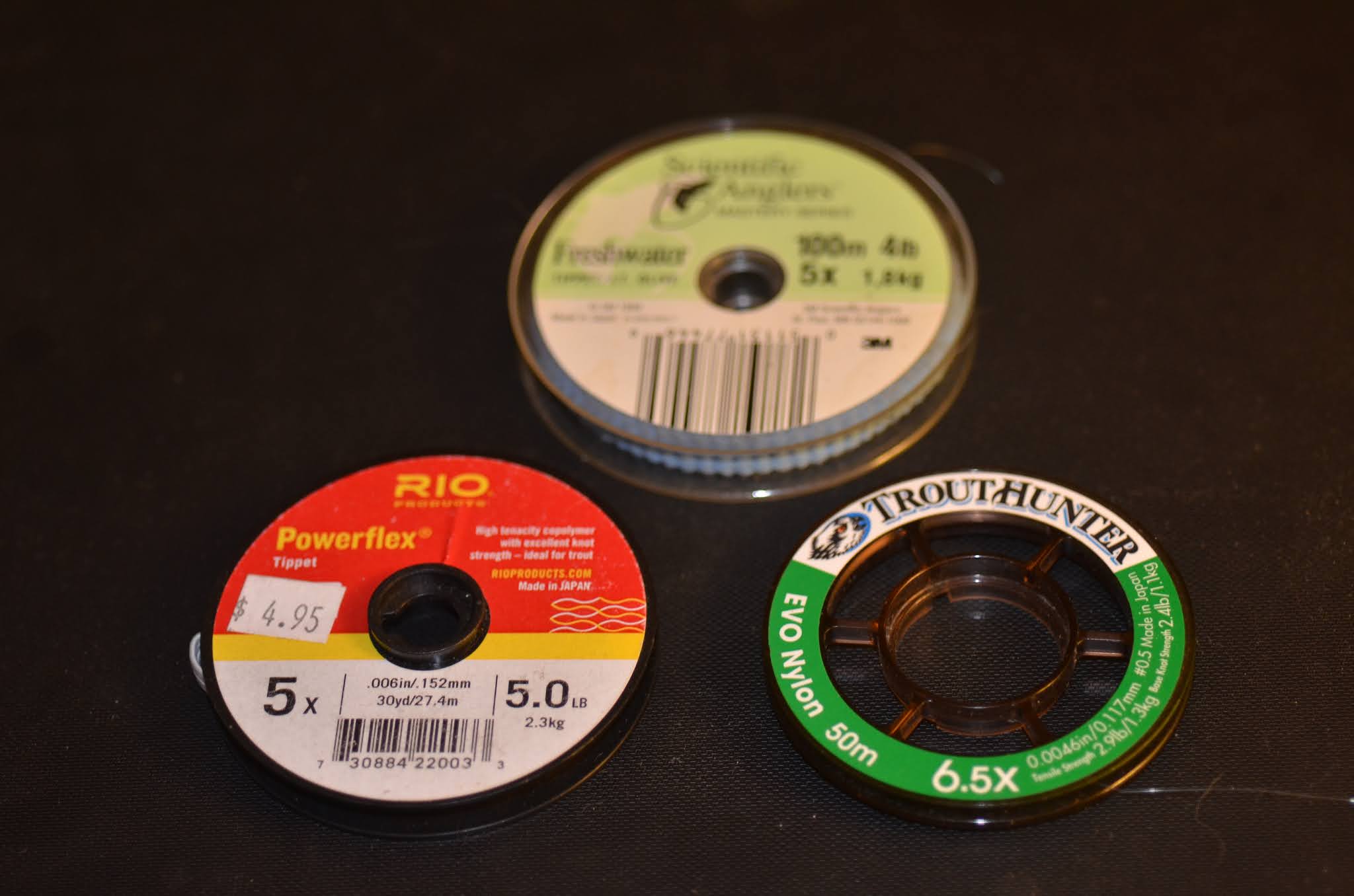
Most other material I'd consider as soft material.  That includes Rio, Orvis, Cortland and Scientific Anglers.  You can add Froghair to this list, too.  All but Scientific Anglers offers tippet material in the larger sizes used for constructing the butt section of a leader.  Orvis, however, does not provide the diameter of their heavier matrial above 0X.  Orvis lists the heavier material by pound test instead.  I think I have it figured out but I won't say without having validation.   We can expand this list by including materials that would otherwise be categorized as spinning line:  Stren, Berkley and some others.  Like I said, there are a lot of choices here.  Even with Stren and Berkley lines we can see the diameter of each one.  Here is one area where I'm always skeptical and I make sure that my micrometer or dial caliper is real handy.  Don't always trust the manufacturer's label.  Example:  Maxima is consistently .002" larger than labeled.  

To be honest, I don't have a really good reason for my choosing to construct my leaders using soft material for the butt section.  It probably stems from the fact that I use Stren spinning line for my butt section on my leaders that I use for fishing dries.  Yup, they include sighters, too.  It's just what I do.  And, yes, I tie them so they turn over well when fishing dries.

Interestingly, George Harvey, considered by many to be the dean of fly-fishing, used stiff mono in his leaders for many years;  however, in later years he switched to all soft mono.  There were a lot of gasps within the fly-fishing community when he revealed this.  As much as Mr. Harvey experimented we have the same opportunity available to us and this is one of the great benefits of making our own.  We can try both and decide which we prefer.  

To me, the real business end of the leader is the tippet.  I'd have to say that a standard tippet length is 2'.  It'll get the job done.  I definitely go with longer tippets.  I don't want my tippet to lay out straight when it lands on the surface;  rather, I want that slack that's easier to get with a longer tippet.  That's why I go with a minimum tippet length of 3' and I'm not averse to going with 4'.  There are exceptions here.  When I'm fishing small streams with a short leader my tippet may even be less than 2'.  

There are some fly fishers who believe that instead of reducing the size of the tippet they can get a better drift just by increasing the tippet length.  I've seen this in action.  I was fishing with a friend several (actually many, many) years ago and he was fishing a #28 dry fly on a very long 5X tippet.  And he was catching fish.  I was right beside him fishing a slightly larger fly on a 7X tippet.  I've known for more years than I'd like to admit that trout are NOT leader (diameter) shy:  they are drag shy.  Even after having seen it with my own eyes I still could not get myself to go the other way.  I still go with fine tippets to try to beat drag.  Finer diameter means more suppleness and that's the route I go.  There is one caution flag I'll raise here.  With very fine tippet I can go too long.  I know it when I see my fly drifting in a pile of 7X tippet material. That ain't good. 

As of today I'm using Orvis or Rio tippet material with some Cortland thrown in the mix.  I've just begun using Trouthunter.  It's not so much that I'm behind the eightball.  The hang-up here is cost.  Trouthunter is a heck of a lot more expensive than the others.  It's going to take a lot of fishing with this stuff to determine if it's worth it and I don't know if I'm willing to part with the extra dollars to do so.  Hrumph!


Another consideration is the supple tippet material that's offered by one or more manufacturers.  Supple should be softer.  Supple material would be more difficult to turn over a fly.  My advise is to keep tippet length shorter if you choose to use the more supple material.

And while I'm at it here's another caution flag.  Beware the "new, improved, stronger" material some companies have rolled out.  I have found they are up to .002" larger diameter than what they're labeled.  Think you're fishing 4X?  It could be the equivalent of 2X!

WRAP-UP

So, there you have it.  You want simple and you don't want the hassle or challenge or satisfaction of going the DIY route the knotless option is for you.  If you get off on the challenge of experimentation and being able to modify a leader profile to present a fly the way you want it then the DIY option is for you.  Oh, and for those who want to construct their own but don't necessarily have the time nor want to get involved messing around with all the variables there are a lot of recipes on the internet.  And that's the long and short of it...and most everything in between. 

Here's to wishing you some really great dry fly fishing opportunities!!


Newer Posts Older Posts Home

POPULAR POSTS

  • ANOTHER MAYFLY EASY ON THE EYES: SLATE DRAKES ARE BIG!!
  • DAVE ROTHROCK'S APPROACH TO FISHING NYMPHS PART 3: LINES AND LEADERS
  • DAVE ROTHROCK'S APPROACH TO FISHING NYMPHS PART 1: AN INTRODUCTION
  • (no title)
  • DRY FLY LEADERS FOR TROUT: THE LONG AND SHORT OF IT...AND WHAT'S IN BETWEEN
  • DAVE ROTHROCK'S APPROACH TO FISHING NYMPHS PART 2: RODS AND REELS
  • STOCKED OR WILD: THAT IS A QUESTION
  • THE RANTING ANGLER BLOG: WHY AND WHAT'S TO COME
  • (no title)
  • (no title)

Categories

  • brook trout 1
  • brookies 1
  • brown trout 1
  • hatchery trout 1
  • Iso 1
  • Isonychia 1
  • mayfly 2
  • sipping trout 1
  • Slate Drake 1
  • slow water 1
  • stocked trout 1

Search This Blog

Powered by Blogger.

Blog Archive

  • ▼  2023 (2)
    • ▼  March (1)
      •                              A WINTER/EARLY SPRING...
    • ►  January (1)
  • ►  2022 (6)
    • ►  December (1)
    • ►  August (1)
    • ►  March (1)
    • ►  February (1)
    • ►  January (2)
  • ►  2021 (8)
    • ►  December (1)
    • ►  September (1)
    • ►  August (1)
    • ►  July (2)
    • ►  June (2)
    • ►  May (1)
  • Home
  • Home
  • About Me

Featured Post

Popular Posts

  • DRY FLY LEADERS FOR TROUT: THE LONG AND SHORT OF IT...AND WHAT'S IN BETWEEN
  • ANOTHER MAYFLY EASY ON THE EYES: SLATE DRAKES ARE BIG!!
  • DAVE ROTHROCK'S APPROACH TO FISHING NYMPHS PART 3: LINES AND LEADERS
  • DAVE ROTHROCK'S APPROACH TO FISHING NYMPHS PART 2: RODS AND REELS

Trending Articles

  • ANOTHER MAYFLY EASY ON THE EYES: SLATE DRAKES ARE BIG!!
  • DAVE ROTHROCK'S APPROACH TO FISHING NYMPHS PART 3: LINES AND LEADERS
  • DAVE ROTHROCK'S APPROACH TO FISHING NYMPHS PART 1: AN INTRODUCTION
  • (no title)

Designed by OddThemes | Distributed By Gooyaabi